Table of Contents
Your vehicle’s cooling system performs two primary functions. The first function is to keep the engine from overheating by flowing coolant throughout. The second function is to provide heat inside the vehicle.
When your vehicle is first started, the engine is relatively cold. It does not take much time for it to heat up based on all of the moving parts within the engine, however. Without a cooling system in place, the engine would eventually overheat.
Here is an overview of how the cooling system works:
How Your Car’s Cooling System Works
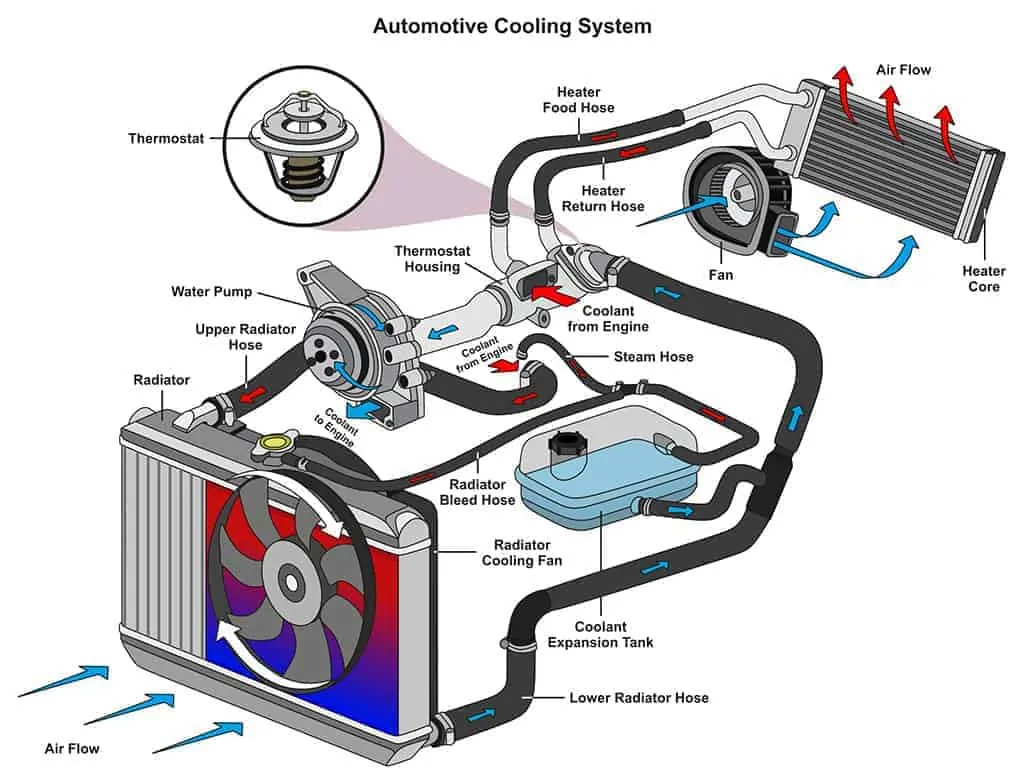
The engine uses a coolant (often referred to as antifreeze) to flow through the engine because it has a higher boiling point than water as well as anti-corrosive properties that water does not have.
The water pump is the mechanism that forces the water to flow through the cooling system via a network of hoses, and it is set in motion by a drive belt or your engines timing belt. Over time, drive belts need to be replaced, and therefore should be inspected periodically (i.e. whenever you have your oil changed.) The life of the belts will vary by manufacturer. The water pump will typically last 60,000 to 90,000 miles and we recommend replacing your timing belt and other drive belts any time you replace your water pump since there is a lot of labor involved and those components usually need to come off in the process.
The coolant flowing throughout the cooling system is restricted from flowing to the heater core by a thermostat, which is a heat-sensitive device that opens only after the engine reaches a certain temperature. This is to allow for the engine to heat up first, as it will run more efficiently when it is warmer. Once the coolant is flowing past the thermostat it reaches the heater core – which is how you get heat inside the car. When you turn on your heat switch, a fan motor engages blowing across the heater core – which now has warm coolant inside of it – thus generating heat for the passenger compartment.
Last, but certainly not least is the radiator, which is the component that most people are familiar with because it sits right in the front of the engine compartment. The radiator houses most of the coolant and keeps the coolant temperature low by allowing air to flow through its coils as the car is driving. When the car is not in motion, the cooling fan is triggered to turn on in order to draw more air through the radiator coils. This is why you may hear your cooling fan turn on while you are sitting at a traffic light. Please note that most cooling systems have an overflow reservoir off to the side of the engine compartment to account for the expansion and contraction of coolant volume as the car engine heats up and cools down.
Over time the cooling system needs to be flushed and have the coolant replaced for a variety of reasons, but most importantly is that the anti-corrosion properties of the coolant only last about 2-3 years (depending on the type used). If your system has had any leaks and the proper ratio of water to coolant was not used, it could hinder the performance of the cooling system.
Cooling System Services We Perform:
- Cooling System Flush
- Drive Belt / Timing Belt Replacement
- Radiator Repair & Replacement
- Coolant Leak Diagnosis
- Cooling Fan / Blower Fan Repair & Replacement
- Overheating Diagnostics
- Heater System Diagnostics
- Heater Core Replacement
Ready to Make An Appointment For Your Cooling System Service?
At Kneble’s Auto Service Center we always want to make the process of getting your car serviced as convenient as possible. To ensure that we can get your car serviced in a timely manner, we ask that you make an appointment for your cooling system service.
We are able to accommodate those who desire to wait for their tune-up as we feature a comfortable waiting area complete with TV, complimentary refreshments, a library, desk, and a charging station. And yes, we even have free Wi-Fi!
In some cases, we may determine that the car needs to stay overnight either due to the time required for service or the unavailability of parts.
If you need service and have not made an appointment you can always feel free to call us at (609) 625-3286 to get on the schedule.
Please note that we offer a shuttle service within a 10 miles radius of the shop (Somers Point, Ocean City, Margate, Brigantine, and surrounding areas).
Frequently Asked Questions About Cooling System Services:
There could be a variety of reasons for overheating including low coolant (accompanied by a coolant leak), a cooling fan not working, a malfunctioning thermostat, or in an extreme case, a worn-out head gasket. Similar to calling your doctor with symptoms, it is next to impossible to give an accurate diagnosis of your car overheating problem without inspecting the vehicle and doing some diagnostic testing. We recommend making an appointment to have one of our cooling system specialists have a look at your car so we can pinpoint the problem for you.
It is very likely that your heater core is leaking and requires replacement. Please contact us to make an appointment to have a further inspection.
If your car is equipped with a warning light letting you know that your car is overheating, you should find a safe place to pull over (preferably off of the road) as soon as possible. We do not recommend opening the hood to inspect the system yourself because of the risk of injury due to steam or coolant that is extremely hot). Contact your emergency roadside assistance provider and ask them to tow your vehicle to Kneble’s Auto Service Center, so we can inspect your car. If your car overheats and you continue to drive it, please know that you can risk doing major (and costly) engine damage.
Coolant color guide: what the different colors mean
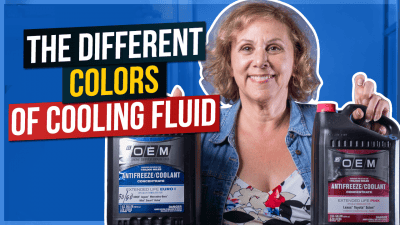
If you’ve noticed fluid under your car and it’s orange or red instead of the green you expected, don’t panic. Coolant comes in a range of colors now, and the color tells you something about the chemistry inside.
Green (IAT). Inorganic acid technology coolant contains phosphates and silicates to prevent corrosion. This was the standard through the mid 1990s. It typically needs to be flushed every two years or so. If your vehicle is older, this is likely what’s in it.
Orange, red, yellow, or purple (OAT). Organic acid technology coolant doesn’t contain silicates or phosphates. It’s designed for newer vehicles with aluminum engine blocks, where it provides better high temperature protection. OAT coolant lasts about five years before it needs to be flushed.
Orange or yellow (HOAT). Hybrid organic acid technology is a blend of IAT and OAT chemistry. Ford and Chrysler vehicles commonly use HOAT coolant. The color can overlap with OAT, so checking your owner’s manual is the only reliable way to know which type your vehicle needs.
Hybrid and electric vehicle coolant. These vehicles have cooling systems designed for the battery pack as well as the drivetrain. The coolant requirements may be different from traditional combustion engines. Always check the manufacturer’s recommendation.
The most important rule: do not mix coolant types. Mixing different chemistries can cause the coolant to gel or lose its corrosion protection, which can damage the cooling system. If you’re topping off, use the same type that’s already in the system. If you’re not sure what’s in there, bring it in and we can test it. Check your maintenance schedule for when the coolant should be flushed, and always use what the manufacturer recommends.
Read the full video transcript
Have you noticed fluid under your vehicle? That looks like a coolant leak. But are you confused, because it’s red in color? You can be fooled because coolant comes in different colors now, orange, red, green, blue, yellow, or pink. Sounds like a rainbow depending on the product used for your vehicle.
Hi, I’m Nancy at Kneble’s Auto Service Center. Gone are the days when green was the only color for coolant. Inorganic acid technology, or IAT, cooling contained phosphates and silicates to help prevent corrosion. Only lasting around two years was typical in the mid 90s. And that color of the coolant was green.
Today’s technology has allowed coolant to have different properties lending itself to different colors. With the newer vehicles, there is organic acid technology, or OAT, which doesn’t contain silicates or phosphates. This chemical compound provides protection against higher temperatures for those aluminum block engines. And they typically come in red, orange, yellow, or even purple in color, with a life for about five years.
There was also a hybrid organic acid technology or HOAT. This is a mixture of both the IAT and the OAT, hence a hybrid coolant, which could be orange or yellow in color. And that’s commonly used by Chrysler and Ford vehicles.
Since hybrid and electrical vehicles have a cooling system designed for the battery pack, check the manufacturer’s recommendation for their specific coolant needed. Before putting coolant in your vehicle, always check the manufacturer’s recommendation to determine the coolant of choice. Do not mix coolant. That could cause damage to the cooling system.
Schedule an Appointment for Your Cooling System Repair
Cooling System Knowledge Base
Cooling System Videos




Cooling System Articles
Where to Get Your Vehicle’s Cooling System Repaired?
Our Address
5473 Somers Point Road
Mays Landing, NJ 08330
Our Hours
Monday – Friday: 8:00am – 5:00pm
Saturday:
8:00am – 4:00pm
Sunday: Closed