
Table of Contents
Your car’s engine is the powerplant that provides the driving force for the vehicle. It is lubricated by oil which flows throughout various ports built into the engine block, and it has multiple interconnected systems that allow it to function including:
The Electrical System – The car battery powers the starter, which engages with the flywheel to turn the engine over to start the engine.
The Fuel System – Delivers fuel to the engine via the carburetor or fuel injection system.
The Ignition System – Provides electricity to the spark plugs to ignite and burn the gas.
The Cooling System – Responsible for keeping the engine from overheating. It is important that your car’s engine is not allowed to overheat as this can lead to costly damage such as head gasket damage, warped cylinder heads, or (in extreme cases) a warped engine block.
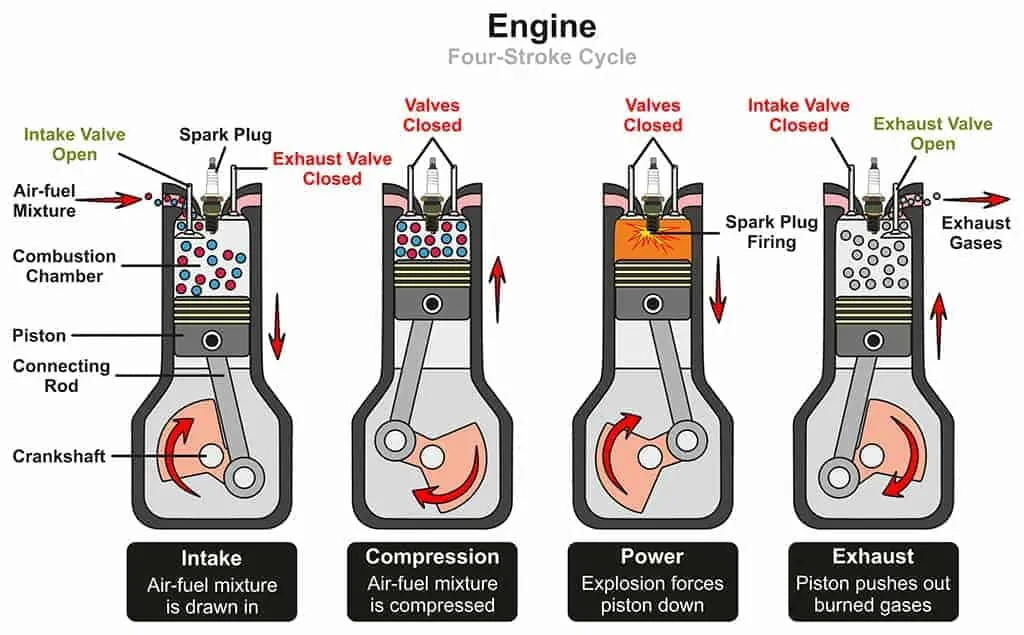
Mechanically, the engine has a valve train driven by a camshaft that opens and closes the valves in sequence to allow for air & fuel to enter the engine to be burned, and for the exhaust to exit the engine. The valve train is connected to the crankshaft which rotates and drives the pistons up and down to create the rotating motion of the engine. The camshaft and crankshaft are connected by a timing chain or a timing belt. It is critical that the camshaft and crankshaft are positioned properly such that the valves open and close and the right time in relation to the pistons moving up and down within the engine block.
Typical engine maintenance includes periodic oil changes, valve cover gasket replacement, valve adjustments, and (at higher mileage intervals) timing belt replacement.
Engine Services & Repair We Perform:
- Oil Changes
- Timing Belt Replacement
- Cylinder Head Replacement
- Head Gasket Replacement
- Oil Leak Repair
- Oil Consumption Diagnosis
- Engine Noise Diagnosis
- Valve Adjustment
- Engine Replacement
Ready to Make An Appointment For Your Engine Repair?
At Kneble’s Auto Service Center we always want to make the process of getting your car serviced as convenient as possible. To ensure that we can get your car serviced in a timely manner, we ask that you make an appointment.
We are often able to accommodate those who desire to wait for their engine repair, however, most engine repairs would require the car to be in the shop all day or even overnight. For those waiting, we feature a comfortable waiting area complete with TV, complimentary refreshments, a library, a desk, and a charging station. And yes, we even have free Wi-Fi!
If you need service and have not made an appointment you can always feel free to call us at (609) 625-3286 to get on the schedule.
Please note that we offer a shuttle service within a 10 miles radius of the shop (Atlantic City, Ocean City, Margate, Longport, Brigantine, and surrounding areas).
Frequently Asked Questions About Engine Repair:
There are a variety of things that could cause noise coming from your engine. One thing you can do is check the oil to ensure that it is not low because if it is, the engine could become noisy due to a lack of lubrication. Other problems such as a valve train failure could cause similar noise. Ultimately, we recommend making an appointment to have one of our ASE Certified Technicians assess your vehicle’s engine to determine the cause of the noise.
As cars get older, engine parts wear and this can cause the engine to burn more oil than normal. There could also be an oil leak that you are not able to see that does not leave any residue on your driveway. We can assist you in determining if your car’s engine is leaking oil or consuming oil due to an internal engine failure.
Depending on the manufacturer, there may be more than one “check engine” light in your dashboard. Initially. cars had “engine” warning lights that would come on in the event of low oil pressure or overheating. Modern computer-controlled vehicles use a “check engine” light to indicate a malfunction recognized by the car’s computer (or electronic control module). This could mean that the car is overheating, but in most cases, it is because a sensor is reading data to indicate that there is a problem. It is recommended to bring your car in to have the problem diagnosed, which will often include a computer system diagnostic check to see if any trouble codes were set by the computer.
Timing belt vs. timing chain
Your engine uses either a timing belt or a timing chain to synchronize the camshaft and crankshaft. That synchronization controls when the valves open and close relative to the pistons moving up and down. If the timing is off, the engine won’t run right. If the belt breaks, the engine stops.
The key difference: a timing chain is metal and generally lasts the life of the engine with no scheduled replacement. A timing belt is rubber, and it wears out. Most manufacturers recommend replacing the timing belt between 60,000 and 100,000 miles. Check your owner’s manual or ask your service advisor which one your car has.
You can’t see the timing belt without removing its cover, so there’s no easy visual inspection. But there are warning signs that it’s wearing: loss of power, slow acceleration, or a rattling noise at idle that goes away when you rev the engine.
When we replace a timing belt, we recommend doing the tensioner, idler pulley, water pump, and cam/crank oil seals at the same time. These parts have the same service life as the belt, and the labor to access them is the same job. Replacing them all at once saves you from paying for the same disassembly twice.
If the belt breaks on an interference engine (where the valves and pistons occupy the same space at different times), the pistons can collide with open valves. That usually means bent valves, damaged pistons, and a repair bill that dwarfs the cost of a scheduled belt replacement. A non-interference engine won’t suffer internal damage, but you’ll still be stranded and need a tow.
Don’t gamble with it. This is one of those scheduled maintenance items that costs a fraction of what the failure costs. If you’re unsure when yours was last replaced, call us at 609-625-3286 and we’ll look it up.
Read the full video transcript
Hi, I’m Nancy at Kneble’s Auto Service Center. Belt or chain? Now I’m not going to be talking about clothing accessories. Today I’m going to be talking about your timing belt or your timing chain. Now, if you have a timing chain in your vehicle, this is maintenance-free. But if you have a timing belt in your vehicle, this requires maintenance. So, check your owner’s manual or consult with your service advisor to see what is operating in your vehicle, whether it’s a belt or a chain.
So, for those of you that have a belt, listen closely because this requires maintenance. You don’t want to wait for this to break. The timing belt does exactly that. It times the opening and closing of the valves with an up and down motion of the pistons. So, if your timing belt breaks and you have what’s called an interference motor, there’s a chance this belt could collide with your pistons causing severe damage to your engine and leaving you stranded on the side of the road waiting for a tow truck.
If you have what’s called a non-interference motor, you’re going to be doing less damage, but you’re going to be stranded on the side of the road waiting for the tow truck. So, make sure you check what the manufacturer recommends for your vehicle to have the timing belt replaced. It’s done by miles. It’s usually between 60 to a hundred thousand miles.
See the timing belt is covered by a metal or plastic cover. So, you can’t readily see the condition of the belt. And as the belt stretches, the engine can have lack of power, it can have a slow pickup, and there can be a rattle noise at an idle and goes away when you rev up the engine. So, when you get your timing belt replaced according to your schedule, we suggest you replace other parts because a timing belt is a lengthy job to replace.
There are other components involved. You have the tensioner, you have the pulley, you have the water pump, and you have the oil seals at the cam and crankshaft. These items can wear over time and we recommend them to be replaced so that you don’t do damage to your engine. So, don’t gamble with your vehicle. Make sure you check this scheduled maintenance for the timing belt to be replaced. Don’t be stuck on the side of the road waiting for that tow truck.
Engine replacement options: used vs. rebuilt vs. remanufactured
Getting told your engine needs to be replaced is about as fun as it sounds. But if the vehicle is otherwise in good shape and worth keeping, you have three options. Each comes with tradeoffs in cost, warranty, and risk.
Used engines come from salvage yards. They’re pulled from wrecked or retired vehicles, and the maintenance history is usually unknown. A used engine is the cheapest option, but the warranty is typically 30 days on the part only. If the used engine fails, you pay the labor to install it again. That risk is the real cost.
Rebuilt engines start with your existing engine (or a core). A technician disassembles it, replaces worn components like pistons, seals, bearings, and rods, cleans everything, and reassembles it to factory tolerances. The warranty is usually better than a used engine, often covering parts and labor.
Remanufactured engines go further. Every wearable component is replaced to meet or exceed original manufacturer specifications, and the engine goes through rigorous testing before it ships. Warranties on remanufactured engines are the strongest of the three, often three years or 100,000 miles with parts and labor coverage.
If it’s financially feasible and the engine is available, remanufactured is the best option. But any of the three can be the right call depending on the vehicle’s value and your budget. The important thing is understanding exactly what you’re getting and what the warranty covers before you commit.
Read the full video transcript
You get that dreaded call from the auto technician that your vehicle has been diagnosed with needing an engine. It almost feels like you’re punched in the gut, especially if you still owe money on this vehicle. Now, what are your options?
Hi, I’m Nancy at Kneble’s Auto Service Center. You love the vehicle. So, do you move forward in having an engine installed? It is important to understand your choices. So, you make an educated decision. Let me help navigate you through these options. Most of you may have the choice of a used, rebuilt, or remanufactured engine. Now there are differences.
Used engines, they’re just that, they’re purchased from the junkyard. The history of the vehicle, where they came from, usually isn’t known and they may have high mileage on that vehicle or have had poor maintenance. Quite often, those vehicles have been in an accident and there may be damage not readily known. So, when choosing a used part, know the warranty, if that used part fails and it needs to be replaced again. Used engines definitely are the cheaper route with a shorter warranty, usually 30 days. But the biggest negative is if they fail, you may be paying labor to have it installed all over again. Junkyards usually warranty the part, but they do not pay for the labor for the re-install.
Rebuilt engines refer to servicing or rebuilding the faulty component and replacing worn parts, such as pistons, seals, bearings, and rods, just to name a few. The engine is cleaned and inspected to make sure other parts are usable and acceptable to the manufacturer’s recommendation. When having rebuilt parts installed, make sure you understand the warranty if that rebuilt part fails and you must get it replaced again. Usually rebuilt engines and remanufactured engines have the same warranty covering the part and labor.
Remanufactured engines maybe another option. Now during the remanufacturing process, all the parts are as close as possible to being new to the recommendation of the manufacturer to meet the highest specifications. Usually, vigorous testing is done, so the parts meet the manufactured standards. Warranties for the remanufactured part may have the same or better warranty than the rebuilt or that used part, such as three years or a hundred thousand miles parts and labor. Now, if it’s financially feasible and if the engine is available, remanufactured may be the first choice. Now it’s an expensive repair. So make sure you understand exactly what you’re purchasing and ask yourself, is your vehicle worth making this investment?
How engine overheating damages your vehicle
A common mistake: the temperature gauge spikes, you pull over, let the engine cool, and keep driving until it overheats again. Every time you do that, you’re compounding the damage.
Here’s what overheating actually does inside the engine:
Cracked or warped head gasket. The head gasket seals the space between the engine block and cylinder head. Excessive heat compromises that seal. Once the gasket cracks, coolant can leak into the cylinders, the oil passages, or both. A head gasket replacement is a major repair.
Warped cylinder heads. Heat causes aluminum cylinder heads to expand unevenly. When the sealing surfaces are no longer flat, combustion pressure escapes through the gaps. Warped heads often need to be machined or replaced entirely.
Piston and cylinder damage. Aluminum pistons and cylinders expand when they overheat. In extreme cases, pistons can score the cylinder walls or seize altogether.
All of these repairs are expensive, and all of them start with ignoring the temperature gauge. If you see it climbing toward hot, pull over in a safe area and have the vehicle towed. Don’t drive it. The tow bill is a fraction of the repair bill.
If your car has been running hot, the cooling system is the first place to check. A failing thermostat, low coolant, or a bad water pump can all cause overheating. A coolant flush on schedule helps prevent buildup that restricts flow.
Read the full video transcript
What kind of damage is overheating your vehicle doing to your engine? Hi, I’m Nancy at Kneble’s Auto Service Center. I can’t tell you how many times I’ve heard, “My temperature gauge went up to hot, but I pulled over. It’s okay. I let the engine cool down, and then I continued driving again. I know, only to stop again when the gauge went back up.” “Ouch,” I say. What is that doing to your engine? Take overheating your engine seriously, as it can do serious and costly damage.
With your engine running hot, it could crack or warp the head gasket or cylinder heads. Now when the head gasket is cracked, your coolant may go everywhere and cause havoc on the engine. A cracked head gasket would need to be replaced. When the cylinder head is warped, then sealing surfaces are no longer flat, and the combustion pressure forces itself into gaps.
Overheating the engine can cause pistons and cylinders to expand if they’re made of aluminum. Now of these symptoms, what they translate to you: expensive repairs. So avoid potentially being faced with a major decision of repairing your damaged head gasket or your cylinder heads. If you notice that temperature gauge going to hot, immediately stop your vehicle, of course in a safe area, and have that vehicle towed to your car care specialists.
Drive belt inspection and maintenance
Your engine may have one, two, or three drive belts (also called serpentine belts or V-ribbed belts). These belts power the alternator, power steering pump, air conditioning compressor, and water pump. If a belt snaps, some or all of those systems stop working, and you’re likely stranded.
Modern belts last longer than they used to, but they still wear. Here are six things to check:
- Cracks. Rubber gets brittle with age and heat. Visible cracking means the belt is near the end of its life.
- Splitting. Aged rubber can thin out and start to split along the length of the belt.
- Fraying on the edges. This usually means a pulley is misaligned, causing the belt to track off center.
- Oil or coolant contamination. Fluids soften rubber and accelerate failure. If you see fluid on the belt, there’s a leak somewhere that needs to be addressed first.
- Missing rubber chunks. Any missing material means the belt is breaking down.
- Looseness or noise. A stretched belt squeals, especially on startup or when turning the steering wheel. A belt gauge can measure the groove depth to determine if replacement is needed.
Belt failure isn’t just an inconvenience. If the belt drives the water pump, losing it means the engine overheats. If it drives the alternator, the battery drains and the car dies. A belt inspection takes minutes and should be part of every routine service visit.
Read the full video transcript
Hi, I’m Nancy at Kneble’s Auto Service Center. Now last week we were talking about timing belts. Today we’re going to talk about drive belts. Your vehicle can have one, two, or even three drive belts in them. The drive belts operate the alternator, the power steering, the air conditioning, and the cooling system.
Now there are two types of drive belts. There’s what’s called the V-ribbed belt, or the serpentine belt. Now in today’s belts, they last longer and they don’t show visible signs of wear as easily. So what I’m going to do is give you six things to look at when you’re inspecting your belt, because you don’t want your belt to fail, possibly causing damage to your engine and leaving you stranded on the side of the road.
So, number one: the first thing to look for is to check your belt and see that it’s not cracked because as rubber ages it gets brittle and starts to crack. The second thing you want to check is as, once again, rubber ages, it gets thin and starts to split, so make sure your belt isn’t split. Number three: if your pulley is not aligned, the belt can start to fray on the side, so check for fraying. Number four: make sure there is no oil or coolant on the belt as this can soften the rubber and cause it to break. Number five: make sure when you’re looking at the belt that there are not any missing rubber pieces worn, that your rubber is intact. And number six: make sure the belt isn’t loose, that as time wears on, your belt can start to stretch, and a loose belt has noise.
Now what we use is a belt gauge, and this is done by actually putting the belt gauge in the groove, and it can only be done on a serpentine belt. You put the belt gauge in the groove. Now, if the belt gauge is deep in the groove and is flush with the belt, then you know the belt is in good condition. If it’s slightly raised higher than the belt, then it’s time to change your belt.
Please check your belt, inspect it. You don’t want it to fail and to be stuck on the road waiting for that tow truck.
Schedule an Appointment for Your Engine Repair
Engine Knowledge Base
Engine Articles
Should I Repair or Replace My Vehicle?
Dealing with a damaged vehicle, but unsure whether you should repair it or replace it? Use this guide to help you make your decision today!

The Dangers of Driving Your Car Through Flood Water
Did you know driving a car through flood water can potentially ruin its engine? Learn about the damages flood waters can do to your vehicle.
Engine Videos
































Where to Get Your Vehicle’s Engine Repaired?
Our Address
5473 Somers Point Road
Mays Landing, NJ 08330
Our Hours
Monday – Friday: 8:00am – 5:00pm
Saturday:
8:00am – 4:00pm
Sunday: Closed