What we handle
Cooling repair and diagnostics in Mays Landing, NJ
Eight bays, foreign and domestic, with the diagnostic equipment to triage every modern cooling system from belt-driven water pumps on a 1996 Civic to electric water pumps on a 2024 BMW. Family-owned in Atlantic County since 1981.
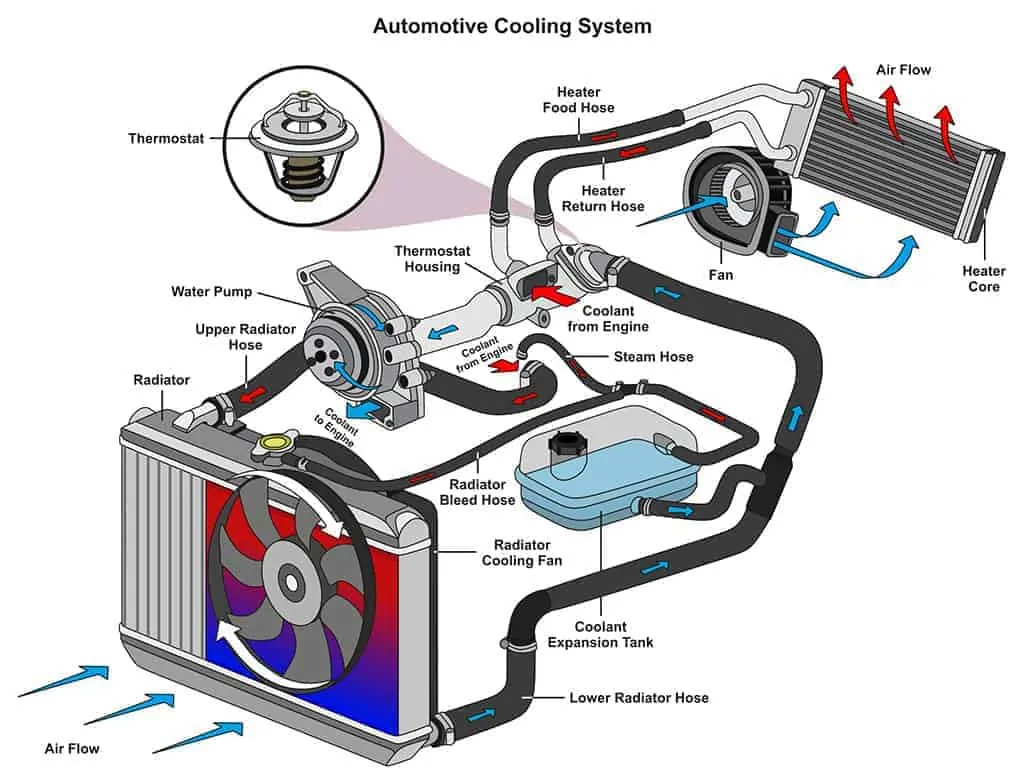
Water pump and thermostat
Belt-driven, chain-driven, electric, and hybrid auxiliary pumps. Mechanical and electric thermostats. Plastic housings on European platforms that crack with age. We diagnose which one failed before quoting either, because they share symptoms and replacing the wrong one leaves the original overheat.
Common examples: Belt and chain-driven pumps, Electric water pumps, Thermostat replacement and housing leaks, Hybrid auxiliary cooling pumps
Radiator and expansion tank
Plastic end-tank failure is the dominant mode on most domestic and Asian platforms past 100,000 miles. Internal leaks require a different repair path than external leaks. Cracked expansion tanks and overflow bottles look like nothing until the system loses pressure and the gauge spikes. Heater core failure shows up inside the cabin; we cover that on the heating system repair page.
Common examples: Radiator replacement (plastic end-tank or all-aluminum), Expansion tank and overflow bottle leaks, Hose, clamp, and reservoir replacement, Internal vs external leak diagnosis
Coolant flush and identification
Coolant chemistry is platform-specific. Mixing chemistries gels the fluid and strips the corrosion protection that keeps your water pump bearings alive. We identify what is in the system, drain and flush per the manufacturer procedure, and refill with the correct spec. See our manufacturer-recommended schedule for coolant intervals across every platform we touch.
Common examples: G05, OAT, HOAT, IAT, Si-OAT chemistry, VW G12 plus and G13, Honda Type 2, Toyota Super Long Life, Mercedes 325.5 and BMW LL-01 spec, Vacuum-fill and bleed per the manufacturer procedure
Head gasket triage and pressure diagnostics
Overheating without a visible leak is the cooling symptom that costs the most when it gets ignored. Combustion-gas test confirms head gasket failure before the bill gets quoted. Compression test on each cylinder narrows it to which one is leaking. Stand-alone cooling pressure test catches the intermittent leak the eye cannot see. If the test confirms a head gasket, the job transitions to engine repair and the cooling work becomes the first hour of a longer fix.
Common examples: Combustion-gas test (Lisle 23000), Cooling system pressure test as stand-alone diagnostic, Cylinder compression test, Head gasket vs water pump triage
If you drive a Honda Civic or CR-V, a Toyota Camry or RAV4, a Subaru Outback or Forester, a Ford F-150 or Explorer, a Chevy Silverado or Equinox, a Jeep Grand Cherokee, a Hyundai Tucson, a Kia Sorento, an Audi Q5, a BMW 3-Series, or a Mercedes C-Class, we have done that cooling job before in this shop.
Signs your cooling system needs repair
Cooling failures are progressive. The warning shows up weeks or months before the actual breakdown. Catch one of these early, the bill is small. Wait for the gauge to spike on the Atlantic City Expressway in August, and the bill grows fast.
Engine overheating in stop-and-go or on the highway
Flow is dropping. Worn water pump impeller, stuck thermostat, restricted radiator, or low coolant level. The temperature gauge moves before the warning light, which is why watching it in Egg Harbor Township traffic matters.
Sweet coolant smell with no visible puddle
A pressurized cooling system can leak a small amount that flashes off the hot exhaust manifold before it ever drips. The smell is ethylene glycol on hot metal. Plastic thermostat housings on the VW and Audi EA888 family are a notorious source of this one.
Low coolant warning that comes back after refills
You topped off the expansion tank last week and the warning is back this week. Slow pressurized leak somewhere the eye cannot see. Pressure test locates it in 20 minutes.
White smoke or steam from the exhaust at start-up
Coolant has reached the combustion chamber, usually through the head gasket or a cracked head. Compression test and combustion-gas test confirm which one. Do not drive far.
Sweet smell or fog inside the cabin
Heater core has cracked. Coolant is leaking onto the passenger-side floor and the windshield fogs greasy from the inside. Bring it in for inspection.
Gurgling sound from the dash or under the hood
Air pocket in the cooling system. Usually the aftermath of a leak that has been ignored long enough that the system has lost coolant volume and is no longer pressurizing correctly.
Heater stopped blowing hot in winter
Low coolant level, failed thermostat, worn water pump impeller, or an air pocket. A common December and January call after a small leak goes unaddressed.
Check engine light with a cooling code
P0128 (thermostat stuck open), P0217 (engine overtemp), or P0480 (fan controller fault) trigger the MIL. Scan-tool freeze-frame data tells us what the engine was doing when the code set. See our check engine light diagnostics page for the broader OBD-II workflow.
Two or more of these at once, do not wait. Driving an overheating engine turns a routine cooling repair into an engine job that costs many times more.
Cooling system repair for Mays Landing and Atlantic County drivers
Same family, same eight bays, same corner of Mays Landing since 1981. We serve Hamilton Township, Egg Harbor Township, Northfield, Somers Point, Folsom, Buena Vista, and the rest of Atlantic County. Fred Kneble has been turning wrenches here for decades. Nancy Kneble runs the shop and the books. ASE-certified, AAA Approved, NJ State Inspection on-site so tag renewal happens here.
Atlantic County summers run hot and humid, and the cooling-failure volume in our shop climbs sharply between Memorial Day and Labor Day. The cars that overheat on the Atlantic City Expressway in July almost always had a symptom we could have caught in May with a pressure test. If you are headed to the shore for the summer or commute the Expressway daily, getting the cooling system inspected before the first heatwave is the cheapest insurance you can buy.
AC-on cooling load is the other big South Jersey factor. The AC condenser sits directly in front of the radiator, so the cooling system has to dump both engine heat AND AC condenser heat through the same airflow. A cooling system that is marginal will pass through April and May, then fail the first 90-degree day in July with the compressor engaged.
Helpful details to mention
- Vehicle year, make, model, and engine (the engine matters for cooling parts)
- Mileage
- Coolant color visible in any puddle, if there is one
- How much coolant you have added in the last month
- Whether the temperature gauge is climbing or steady
- Whether the heater is still blowing hot through every vent
- Most recent shop visit and what they did
The more we know up front, the more accurate the estimate and the timeline.
Customer proof
Service was performed quickly and the Kneble Team provided great communication throughout the visit.Robert Orzechowski, Google review
Questions before scheduling?
Talk with us about Cooling System Repair
Tell us the symptom, the vehicle, and what changed. If it is a routine cooling repair, we book the visit and quote it on arrival. If the symptom points to a head gasket, we say so on the phone so you can decide whether to tow.
Service guide
Cooling System Repair Service Guide
Topic reference for the difference between cooling service and cooling repair, why coolant chemistry matters more than most owners realize, the platform-specific failure points we see most often, how a head gasket job hides inside a cooling complaint, and what to do if your gauge spikes on the road.
In this guide
- Coolant chemistry: why mixing G12 plus with green is the cooling mistake we see most often
- Plastic thermostat housing failure on VW, Audi, and BMW
- Electric water pumps on BMW N20/N55 and modern Mercedes
- Head gasket clues: how to tell before the engine is junk
- The cooling system pressure test: a low-cost diagnostic that saves big repairs
- If your gauge spikes on the Expressway: roadside overheat protocol
- Coolant flush vs drain-and-fill: which one your car actually needs
- Thermostat replacement symptoms: four patterns we see on the scan tool
- Radiator vs water pump leak: the visual triage that decides the repair
- Electric cooling fan failure: overheats at idle, fine on the highway
- Brand-specific coolant quirks: BMW, Subaru, GM, Hyundai-Kia, Mercedes
- POAT, NOAT, Si-OAT, and ethylene vs propylene glycol
- Cooling system services and related spoke pages
01 of 13, Coolant chemistry
Coolant chemistry: why mixing G12 plus with green is the cooling mistake we see most often
People top off with whatever bottle is on the parts-store shelf. Sometimes it works. Sometimes the chemistry gels in the radiator and the bill grows.
Read more about Coolant chemistry: why mixing G12 plus with green is the cooling mistake we see most often
Modern coolants fall into a handful of platform-specific specs. Old green IAT coolant uses phosphates and silicates and was standard through the mid 1990s. Most GM platforms from the late 1990s on use orange Dex-Cool (OAT chemistry). Ford, Chrysler, and many older Mercedes and BMW platforms use yellow or gold G05 (HOAT chemistry). Toyota and Lexus run pink Super Long Life (P-HOAT, pre-mixed only). Honda and Acura run blue Type 2. Volkswagen, Audi, and most modern European platforms run violet G12 plus or G13. Modern Mercedes runs spec 325.5. Subaru runs Super Coolant.
The most common cooling-system mistake we see is not the leak itself. It is the well-meaning top-off with the wrong color coolant. When chemistry gets mixed, the coolant gels in the expansion tank and the system loses corrosion protection. Drain, flush, refill with the correct spec, pressure-test, and the cooling system gets healthy again. The mixed coolant always costs the owner more than just buying the correct fluid would have.
The rule is simple. Top off with the same spec already in the system. When you do not know what is in there, bring it in and we will test it.
From the shop library: Video The Different Colors of Cooling Fluid
02 of 13, Plastic thermostat
Plastic thermostat housing failure on VW, Audi, and BMW
Plastic housings on the VW and Audi EA888 family crack with age and heat cycles. The early symptom is a faint sweet smell with no visible puddle, because the coolant flashes off the hot exhaust manifold before it ever reaches the ground. The repair is the updated OEM housing plus a refill with G13 (VW) or the equivalent platform spec.
Read more about Plastic thermostat housing failure on VW, Audi, and BMW
BMW uses a similar plastic housing on the N20 and N55 engines and pairs it with an electric thermostat on those platforms. When the housing cracks, the failure pattern looks identical to the VW case. When the electric thermostat itself fails, the scan tool reads the fault directly. The repair path is different but the symptom is the same: gauge climbing, sweet smell, no obvious leak. See our VW diagnostic services page for the broader VW cooling and EA888 workflow.
From the shop library: Article Should I Repair or Replace My Vehicle? Video Top 5 Smells You Do Not Want Coming From Your Car
Tell us what changed, when it started, and what you drive. We can help decide whether to start with an inspection, alignment check, or related repair.
03 of 13, Electric water
Electric water pumps on BMW N20/N55 and modern Mercedes
The mechanical belt-driven water pump is being phased out on modern engines in favor of an electric pump driven by the engine control module. The advantage is precise temperature control. The disadvantage is a new failure mode: the pump fails electronically before it fails mechanically, and a scan tool is the only way to confirm it.
Read more about Electric water pumps on BMW N20/N55 and modern Mercedes
BMW N55, Mercedes M276 and M278, and many modern hybrids run electric water pumps. Hybrids add a second auxiliary pump that cools the inverter and the high-voltage battery loop. Diagnosing an electric pump failure without the scan tool turns into parts darts: replace the thermostat, no change; replace the radiator, no change; eventually replace the pump and the gauge stays steady. The scan tool reads pump RPM, commanded flow, and the temperature delta across the cylinder head in ten minutes. See our BMW diagnostic services page for the BMW-specific cooling workflow.
From the shop library: Article The Dangers of Driving Your Car Through Flood Water Video How Engine Overheating Can Destroy Your Vehicle
04 of 13, Head gasket
Head gasket clues: how to tell before the engine is junk
The cheapest moment to find a head gasket failure is before the customer has driven the car home overheating one more time. Three clues separate a head gasket job from a cooling job.
Read more about Head gasket clues: how to tell before the engine is junk
First clue: white smoke or steam from the exhaust at warm start-up. Second clue: milky pink coolant in the expansion tank, sometimes with an oil sheen on top. Third clue: combustion gas in the coolant, detected with a Lisle 23000 block tester (the blue-fluid hand pump that pulls a vacuum across the cap and changes color when combustion gas is present). When two or more of those clues line up, the cooling work becomes the first hour of an engine job, and the conversation with the customer changes accordingly.
Gauge spiking? Want a pressure test before you tow?
Call (609) 625-3286How the combustion-gas test actually works
The Lisle 23000 tester sits a glass cylinder of blue indicator fluid in the filler neck above the coolant. A hand pump pulls a sample of gas across the fluid. If combustion gas (carbon dioxide) is leaking from a cylinder into the cooling system, the CO2 reacts with the blue fluid and turns it yellow or green within two minutes. The test is sensitive enough to catch a partial head gasket failure before the engine shows external symptoms.
From the shop library: Video Why Driving Your Vehicle Can Turn Off Your Check Engine Light
Tell us the year, make, model, and what you are noticing, and we will say what to check first.
05 of 13, The cooling
The cooling system pressure test: a low-cost diagnostic that saves big repairs
A pressure test is a 15 psi shop pump that screws onto the radiator cap or the expansion tank neck. We charge the system to its working pressure cold and then watch for a drop. A system that holds 15 psi for 20 minutes has no external leak. A system that loses 3 psi in five minutes has a leak we can usually pinpoint by walking the engine bay and looking for the wet spot.
Read more about The cooling system pressure test: a low-cost diagnostic that saves big repairs
The reason we run this test before quoting anything: it costs almost nothing and it answers the most important question first. Is this a small fix, a big fix, or the wrong fix? Without it, the shop is guessing, and guessing on a 12-year-old cooling system means replacing the wrong part and having the car back inside the year. With it, we tell the customer the actual scope before any wrench comes out of the tool drawer. See engine repair for the path the conversation takes when the pressure test points at compression rather than coolant.
The radiator/reservoir cap is the cheapest part you have never tested
The pressure cap is rated, typically 13 to 16 psi depending on platform. A weak cap vents pressure early, drops the coolant's effective boiling point, and causes random overheats that no leak inspection ever finds. The cap is a 15-dollar wear item that almost no one replaces; we test it on the same pump with a cap adapter as part of the pressure workflow. On European platforms, plan on replacing the reservoir cap every two to three years.
From the shop library: Video Understanding the Different Fluids that Your Car Requires
06 of 13, If your
If your gauge spikes on the Expressway: roadside overheat protocol
Three rules for the moment the temperature warning light comes on. First, pull off the road safely and turn the engine off. Continuing to drive is how a routine cooling job becomes an engine job. Second, do not open the hood for at least 20 minutes. The steam under pressure at operating temperature is hot enough to cause third-degree burns. Third, call your roadside assistance and have the car towed. If you are within a few miles of Mays Landing, ask for the tow to come to Kneble's.
Read more about If your gauge spikes on the Expressway: roadside overheat protocol
AAA roadside data shows cooling failures climb sharply between Memorial Day and Labor Day. The vast majority of summer roadside breakdowns we see started as a small symptom in May or June.
From the shop library: Article Three Essentials for Road Trips After The Quarantine Video Questions to Ask Yourself When Purchasing a Used Car
07 of 13, Coolant flush
Coolant flush vs drain-and-fill: which one your car actually needs
These are two different services and they are priced differently. A drain-and-fill opens the radiator petcock (or the engine block drain on platforms without one), lets gravity pull out 40 to 60 percent of the system's coolant, and refills with the correct spec. It is the routine interval service and the right call when coolant is clean, on-spec, and just due for its scheduled refresh.
Read more about Coolant flush vs drain-and-fill: which one your car actually needs
A full flush uses a coolant-exchange machine to push fresh coolant through the system while pulling old coolant out, exchanging 95 percent or more of the fluid. The flush is the right call after a head gasket repair, after mixed-coolant contamination, after stop-leak product has been added, or when the coolant tests acidic or shows electrolysis voltage above 0.4 volts. We test before we recommend the flush so you do not pay for the bigger service when the smaller one is enough.
08 of 13, Thermostat replacement
Thermostat replacement symptoms: four patterns we see on the scan tool
Thermostat failure shows up in four distinct ways depending on how the part fails. Each pattern points us at a different diagnosis.
Read more about Thermostat replacement symptoms: four patterns we see on the scan tool
Stuck closed (rapid overheat)
Coolant cannot flow to the radiator. Temperature spikes within five minutes of cold start. Lower radiator hose stays cold while the upper hose is hot. The classic emergency symptom and the one that strands cars on the Atlantic City Expressway in July.
Stuck open (slow warm-up)
Coolant flows to the radiator before the engine reaches operating temperature. Sets a P0128 code (engine coolant temperature below thermostat regulating temperature). Heater works at highway speed but is weak at idle. Fuel economy drops because the engine runs in open-loop fuel mixture longer.
Intermittent (gauge swings)
The wax pellet inside the thermostat is failing partially and the part is cycling unpredictably. Temperature gauge swings high then drops. Often the last pattern before a stuck-closed failure, so it is the warning shot worth listening to.
Electric thermostat (scan-tool fault, no mechanical clue)
BMW, Mercedes, and some Audi/VW platforms use an electronic thermostat controlled by the ECU. When the heater element inside the thermostat fails, the part defaults to a fixed opening temperature higher than spec and the diagnosis only appears on the scan tool as a thermostat heater circuit code. Generic OBD-II readers miss it entirely.
We will walk through the symptoms, give you an honest read, and only recommend what the vehicle actually needs.
09 of 13, Radiator vs
Radiator vs water pump leak: the visual triage that decides the repair
Both fail. The repair paths and the parts cost differ. The visual triage takes 60 seconds with the car on the lift.
Read more about Radiator vs water pump leak: the visual triage that decides the repair
Water pump leak signature
The pump has a weep hole at the center of the pump body, behind the pulley. When the internal seal fails, coolant drips from the weep hole and dries on the timing cover or the front of the engine block as green, orange, or pink crust. The drip is at the front-center of the engine, not at the corners. On serpentine-belt platforms the belt may squeal or get contaminated. On timing-chain platforms (BMW N20, VW EA888) the leak runs down the front of the block.
Radiator leak signature
Modern radiators fail at the plastic end-tank-to-aluminum-core crimped seam first, and at the core fins second. The leak sits at the front of the vehicle, behind the bumper, often dripping onto the AC condenser before reaching the ground. End-tank cracks weep slowly at first and grow fast under pressure. Core fin leaks usually trace to gravel impact damage.
10 of 13, Electric cooling
Electric cooling fan failure: overheats at idle, fine on the highway
A car that overheats sitting in traffic but runs at normal temperature on the open road is almost always a cooling-fan problem. At highway speed ram air through the grille moves enough heat. At idle, the electric fan has to do all the work; if the fan does not turn on, the system has no airflow.
Read more about Electric cooling fan failure: overheats at idle, fine on the highway
The diagnostic walk is fan relay, then fuse, then fan controller module (separate from the fan motor on most modern platforms), then the fan motor itself, then the coolant-temperature sensor that signals the fan controller. AC engagement also commands the fan on most platforms; an AC system that triggers cooling-fan run is a useful test signal. P0480 and P0481 are the common fan-circuit codes; their absence does not rule a fan problem out because some platforms log a generic powertrain code instead.
Audi A4, A6, Q5, and VW Tiguan platforms run a two-stage auxiliary fan with a controller that fails to the low-speed mode silently. The car cools at low load and overheats with the AC on at idle, especially on Atlantic County summer days. We test for the fault on the bench because the symptom is intermittent.
From the shop library: Article How to Stop Rodents From Eating Your Vehicle’s Wires Video Beat the Cold: 4 Expert Tips to Power Up Your Electric Vehicle in Winter
11 of 13, Brand-specific coolant
Brand-specific coolant quirks: BMW, Subaru, GM, Hyundai-Kia, Mercedes
Five brand-specific patterns we keep seeing in the bays. Each one is a different coolant mistake the parts counter cannot warn you about.
Read more about Brand-specific coolant quirks: BMW, Subaru, GM, Hyundai-Kia, Mercedes
BMW G11 is not backward-compatible with G12
BMW switched coolant chemistry from G11 to G12 across the 2010s. The two react and form a brown sludge if mixed. A G11 car topped with G12 (or the other way) will eventually clog the heater core or the water pump impeller. The right call on every BMW visit is to confirm which generation the platform takes before adding coolant.
Subaru EJ engines need phosphate-free coolant
The EJ22 and EJ25 head-gasket platforms specifically require phosphate-free coolant (Subaru Long Life Coolant or equivalent). Standard green or any phosphate-containing coolant deposits onto the head-gasket sealing surface and accelerates the gasket weep that the engine is already prone to. The wrong coolant turns a 200,000-mile head gasket into a 100,000-mile head gasket.
Dex-Cool sludge on neglected GM platforms
GM Dex-Cool that has been neglected past its service interval, or run low on coolant so air gets into the system, turns into an orange mud that clogs heater cores and intake-manifold-gasket coolant passages. The 4.3L V6, 3.4L V6, and 3.1L V6 are the platforms where we see this most often. The fix is a chemical cooling-system clean before refill, not just a flush.
Hyundai/Kia long-life green is not old-school green
Hyundai and Kia use a phosphated organic acid technology (PG-OAT) coolant that is green-tinted but is not the legacy IAT green from the parts counter. Topping a modern Hyundai or Kia with old-style green silicate-inhibited coolant causes the inhibitor package to break down and accelerates water pump and radiator end-tank degradation.
Mercedes 325.5 blue vs 325.6 violet Si-OAT
Mercedes-Benz split coolant specifications between MB 325.5 blue (older platforms) and MB 325.6 violet silicated-OAT (newer platforms, current factory fill on most C/E/S-Class and ML/GLE). The two are not interchangeable. We confirm the platform spec on every MB visit before any coolant work.
12 of 13, POAT, NOAT
POAT, NOAT, Si-OAT, and ethylene vs propylene glycol
The chemistry suffixes on coolant bottles are not branding. Each suffix points to a different inhibitor package, and the wrong package corrodes the wrong metals in the system.
Read more about POAT, NOAT, Si-OAT, and ethylene vs propylene glycol
POAT, NOAT, Si-OAT: the modern OAT variants
OAT (organic acid technology) is the base modern coolant chemistry. POAT (phosphated OAT) is the Asian-OEM variant used by Hyundai, Kia, Toyota, and others; it adds phosphate for additional aluminum protection. NOAT (nitrited OAT) is the heavy-duty diesel variant used in Cummins and Detroit Diesel applications. Si-OAT (silicated OAT) is the Mercedes-Benz and VAG-late-model variant; the added silicate is critical for the iron block / aluminum head combination on those platforms.
Ethylene vs propylene glycol
Ethylene glycol is the standard automotive coolant base (toxic to pets and wildlife if spilled). Propylene glycol is the non-toxic alternative used in RV and marine applications, and as a pet-safe yard-spill upgrade for daily drivers. The two protect equivalently against freeze and boil, but the inhibitor packages are not interchangeable; do not mix.
A quick conversation helps us plan the visit, set expectations, and explain what should be checked before parts are replaced.
13 of 13, Cooling system
Cooling system services and related spoke pages
Cooling work splits across several spoke pages plus the full diagnostic workflow we keep here. The linked pages below have the deeper part-specific detail.
Read more about Cooling system services and related spoke pages
Call the shop or request an appointment and include the vehicle year, make, model, mileage, and symptoms.
FAQs
Cooling system repair FAQs
My car is overheating. What could cause this?
The common causes are a low coolant level from a slow leak, a cooling fan that has stopped working, a failed thermostat stuck closed, a failing water pump, a restricted radiator, or in the worst case a head gasket leak. Without inspecting the vehicle and running the pressure test, no honest shop can give an accurate diagnosis over the phone. Call (609) 625-3286 and we will get you scheduled.
I see antifreeze leaking inside the cabin. What is happening?
The heater core is leaking. The heater core is a small radiator behind the dashboard. When it cracks, you see pink, green, or orange fluid on the passenger-side floor mat and the windshield fogs greasy on the inside. The fog wipes off but comes back the next time the heater runs. Bring it in.
My temperature warning light is on. What should I do?
Pull off the road safely and turn the engine off. Do not open the hood for at least 20 minutes; the steam is hot enough to cause serious burns. Call your roadside assistance provider and have the vehicle towed to Kneble's at (609) 625-3286. Continuing to drive an overheating engine is how a small cooling repair becomes a head gasket job.
How often should I flush my coolant?
It depends on the platform. Old green IAT coolant: every two years. Most modern OAT and HOAT formulas: every five years or 100,000 miles. Toyota Super Long Life: ten years for the first flush, five years after that. VW G13 on modern platforms: every five years. Always follow the manufacturer interval in your owner manual rather than a shop's generic schedule.
Can I top off with whatever coolant is on the shelf?
No. Mixing IAT (green) with OAT (orange), or G12 plus (violet) with HOAT (yellow), can gel the coolant and strip the corrosion protection that keeps your water pump bearings alive. Top off with the same spec already in the system. When you do not know what is in there, distilled water is safe for the drive to the shop. Bring the vehicle in and we will identify the chemistry and refill correctly.
How long does cooling system repair take?
Most cooling jobs finish same-day. A coolant flush runs about two hours. A thermostat is usually two to three hours. A radiator on most domestic and Asian platforms is three to four hours. A water pump on a timing-belt-driven engine, bundled with a belt and tensioner replacement (the right way to do it), is most of a day. Bleed and verification add an hour on top of wrench time on any platform that needs a vacuum-fill rig.
Why pressure-test before quoting? Cannot you just replace the leaking part?
We could, and many shops do. The problem is that one leaking component on a 12-year-old cooling system usually means the rest of the hoses, clamps, gaskets, and seals are the same age. Replace just the water pump on a high-mileage car and the radiator goes inside the year. The pressure test takes 20 minutes and tells us which components are sound, which are weeping, and which are about to fail. Quoting from that map produces one repair that holds, not three repairs that escalate. Being ASE-certified means we are accountable to the workflow.
Why does coolant need to be flushed at all if it does not look dirty?
Because the inhibitors in coolant deplete on a chemistry timer, not on a water timer. The corrosion-inhibitor package, pH buffer, and water-pump-seal additives break down over years of heat cycling regardless of how clean the fluid looks. Coolant that has gone acidic (pH dropping below 8.0) or that shows electrolysis voltage above 0.4 volts is actively eating the radiator, the water pump, and the heater core, even when it looks bright pink or green in the reservoir. The flush replaces the chemistry, not just the water.
Further reading and viewing
Related Kneble's coverage for cooling-system and engine owners
Cooling-system and engine content from the Kneble's library if you want to go deeper.
Related articles

How to Stop Rodents From Eating Your Vehicle’s Wires

Common Causes of a Faulty Car Battery

Should I Repair or Replace My Vehicle?

The Dangers of Driving Your Car Through Flood Water
Related videos

Questions to Ask Yourself When Purchasing a Used Car

Beat the Cold: 4 Expert Tips to Power Up Your Electric Vehicle in Winter
Why Driving Your Vehicle Can Turn Off Your Check Engine Light
Why Your Check Engine Light Does Not Turn Off After A Repair
Local shop
Visit Kneble's in Mays Landing
5473 Somers Point Road, Mays Landing, NJ 08330
Five minutes off Route 40 between the Hamilton Mall and Lake Lenape. Ten minutes from the Atlantic City Expressway Exit 17. Twelve minutes from Egg Harbor Township and Northfield. Fifteen minutes from Somers Point along Mays Landing-Somers Point Road. From Folsom or Buena Vista, take 322 east, then south on Somers Point Road. Freddy J's Bar & Kitchen is nearby at 5698 Somers Point Road if you want to grab food before or after the appointment.
- Mon to Fri 8am to 5pm
- Saturday 8am to 4pm
- Sunday Closed
Reviews
Trusted by South Jersey drivers
Customers come to Kneble's for clear communication, practical recommendations, and repairs handled by a local team they can reach directly.
Friendly receptionist. In and out within 45 mins.
Janet Jackson, Google review
Service was performed quickly and the Kneble Team provided great communication throughout the visit.
Robert Orzechowski, Google review
Excellent quick service by personable staff and very qualified techs at a reasonable charge.
Glenn Peterson, Google review
Very good service here. Treated us very well. Great conversation with Carmen.
Gary Mazzone, Google review