Table of Contents
Your car’s transmission is responsible for converting the power from the engine into rotation of the wheels. There are few additional components that help along the way including the drive shaft(s) and a differential. Additionally, there are two types of transmissions; automatic and manual and with both of these, your vehicle might have a rear-wheel drive or a front-wheel-drive configuration.
Automatic Transmissions Versus Manual Transmissions
A manual transmission is one that has to be shifted by the driver at specific intervals. The manual transmission is connected to the engine’s flywheel via a clutch assembly which allows the driver to manually engage and disengage the engine from the transmission. Over time the clutch will wear out due to the friction created during its usage. Manual transmissions require less maintenance than automatic transmissions and it is not uncommon for them to last for the entire life of the vehicle.
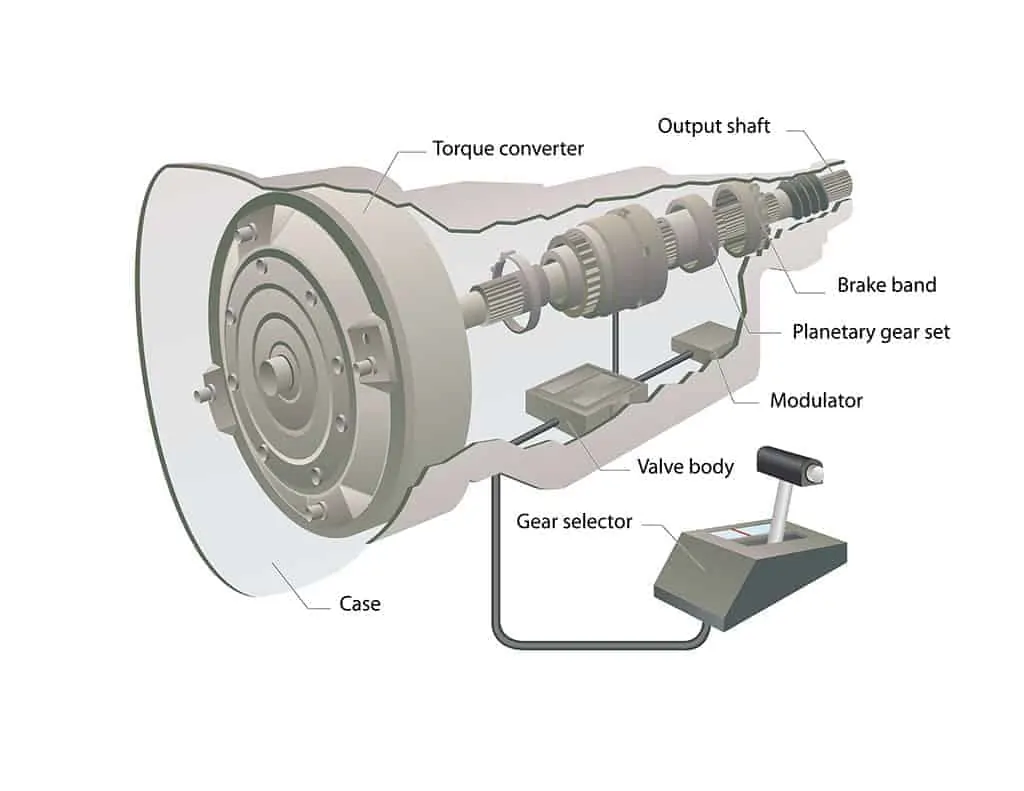
An automatic transmission uses hydraulic fluid to operate and is connected to the engine’s flywheel via a torque converter. The torque converters job is similar to the clutch in that it is responsible for coupling the engine to the transmission to transmit the power from the engine to the transmission. The torque converter uses hydraulic pressure to operate, and that same hydraulic pressure flows throughout the transmission to engage clutches and bands, to change gears automatically.
Older automatic transmissions used a governor to indicate when the transmission should change gears, however, newer vehicles incorporate a transmission control module (a.k.a. TCM or “computer”) which reads various sensors to indicate when you turn on or off a solenoid that will activate a valve allowing the transmission to change gears as needed.
Over time, the internal components (such as friction plates) in an automatic transmission will wear which causes debris to enter the system. This is the reason that a periodic transmission fluid flush is required. If you want to check yours at home, we show you how to check your vehicle’s transmission fluid. Additionally, automatic transmissions incorporate filters or screens that can be cleaned or replaced, to ensure that larger particles do not get lodged in the valve body, solenoid, or other components that could render the transmission inoperable.
A transmission flush is one of those services most people forget about until something goes wrong. Nancy explains why a transmission flush matters and when it’s time.
Front-Wheel Drive Transmissions Versus Rear Wheel Drive Transmissions
Initially, cars were developed such that the rear wheels were responsible for putting the car in motion. Over time, engineers realized that there were lots of benefits to having the front wheels of the car to be responsible for putting the car in motion. This development required a reconfiguration of the transmission, differential, and axles, and what was ultimately created is known as a transaxle assembly. The transaxle assembly combines the transmission and the differential into a single unit which has axles on either side that connect to the wheel assemblies.
Transmission Coolers
As your vehicle is in operation, the transmission fluid in the automatic transmission tends to get hot due to the many internal moving parts that create friction. If the fluid were to get too hot, it could lose it’s chemical properties, so a transmission cooler is a necessary component that allows the fluid to be cooled. Transmission coolers are either incorporated into the radiator or attached to it, so it can be cooled by the airflow across the radiator in a similar manner that the cooling system is kept cool.
Transmission Service & Repairs We Perform:
- Transmission Fluid Flush
- Transmission Leak Diagnosis and Repair
- Torque Converter Diagnosis the Replacement
- Transmission Replacement (Automatic or Manual)
- Transmission Overhaul ((Automatic or Manual)
- Clutch Service and Replacement
- Transmission Cooler Installation and Replacement
Ready to Make An Appointment For Your Transmission System Service?
At Kneble’s Auto Service Center we always want to make the process of getting your car serviced as convenient as possible. To ensure that we can get your car serviced in a timely manner, we ask that you make an appointment.
We are often able to accommodate those who desire to wait for their transmission system service, however major transmission repairs or replacement often require the car to be in the shop for an extended period of time.
For those waiting, we feature a comfortable waiting area complete with TV, complimentary refreshments, a library, a desk, and a charging station. And yes, we even have free Wi-Fi!
If you need service and have not made an appointment you can always feel free to call us at (609) 625-3286 to get on the schedule.
Please note that we offer a shuttle service within a 10 miles radius of the shop (Atlantic City, Longport, Brigantine, Pleasantville, and surrounding areas).
Frequently Asked Questions About Transmission Service and Repair:
A few malfunctions could cause this including a problem with the gear shift linkage, internal transmission damage, or a leak that has caused the fluid to be too low for the transmission to function. In either case, it is something that needs to be assessed by one of our ASE Certified Technicians. If the car cannot be driven, you can contact us to arrange to have the vehicle towed in.
It sounds like your transmission is not holding in gear, otherwise known as “slipping.” This could be caused by low fluid or another internal malfunction. Please contact us to make an appointment to bring the car in so one of our ASE Certified Technicians can inspect the vehicle and diagnose the problem.
This could be caused by a clogged screen or filter, or a worn internal transmission component and requires additional diagnosis by a qualified technician.
Drivetrain vs. powertrain warranty: what’s actually covered?
If you’ve purchased an aftermarket warranty (or are shopping for one), you’ve probably seen “drivetrain” and “powertrain” used as coverage tiers. The names sound different, but in practice they usually cover the same components.
A drivetrain warranty typically covers the parts that deliver power from the engine to the wheels: the transmission (manual or automatic), axles, differential, clutch and flywheel (if applicable), drive shaft, and torque converter.
A powertrain warranty covers everything the drivetrain does, plus the engine. In theory, “powertrain” is the broader term. In practice, most aftermarket warranty providers use the two terms interchangeably and cover the same list of parts under either name.
The important thing is not which label the warranty uses. It’s what’s specifically listed in the contract. Before you buy, ask:
What exact components are covered? Don’t assume. If a part isn’t listed, it’s not covered.
Who pays the labor? Some warranties cover only the part, not the labor to install it. Others cover both.
Are there maintenance requirements? Many warranties become void if you can’t show records of oil changes, fluid flushes, and other scheduled maintenance at the intervals they specify.
An aftermarket warranty can save you from a major repair bill, but only if you understand exactly what you’re buying. Read the contract, not just the brochure.
Read the full video transcript
Don’t let this happen to you. You buy a warranty for your vehicle. Costs you a lot of money, and when you go to use it, you find that the repair isn’t even covered.
Hi, I’m Nancy at Kneble’s Auto Service Center. Aftermarket warranties, they can be expensive, so make sure you know what’s covered. For instance, what’s the difference between a drivetrain warranty or a powertrain warranty? Drivetrain, that’s defined as parts that provide power to the wheels such as your transmission, whether it’s manual or automatic, your axles, your differential, your clutch, and flywheel if they apply, your drive shaft and your torque converter.
Now, a powertrain is defined as every component that makes the vehicle move from the engine to the wheels. The engine, drive shaft, differential, transmission, transfer case with four wheels or all-wheel drive. But I found out in this industry drivetrain and powertrain warranties cover the same components. They use two different words while covering those same parts.
Ask questions. Make sure you understand your purchase and know what you the customer is responsible for. Thank you for watching.
Schedule an Appointment for Your Transmission Repair
Transmissions Knowledge Base
Transmissions Videos


Transmissions Articles
Should I Repair or Replace My Vehicle?
Dealing with a damaged vehicle, but unsure whether you should repair it or replace it? Use this guide to help you make your decision today!

The Dangers of Driving Your Car Through Flood Water
Did you know driving a car through flood water can potentially ruin its engine? Learn about the damages flood waters can do to your vehicle.
Where to Get Your Vehicle’s Transmission System Repaired?
Our Address
5473 Somers Point Road
Mays Landing, NJ 08330
Our Hours
Monday – Friday: 8:00am – 5:00pm
Saturday:
8:00am – 4:00pm
Sunday: Closed