
Table of Contents
On a car with a manual transmission, the clutch system contains the components responsible for engaging and disengaging the engine and transmission. Due to the friction created and frequent motion, these components wear out over time and need adjustment or replacement.
How Does the Clutch Work?
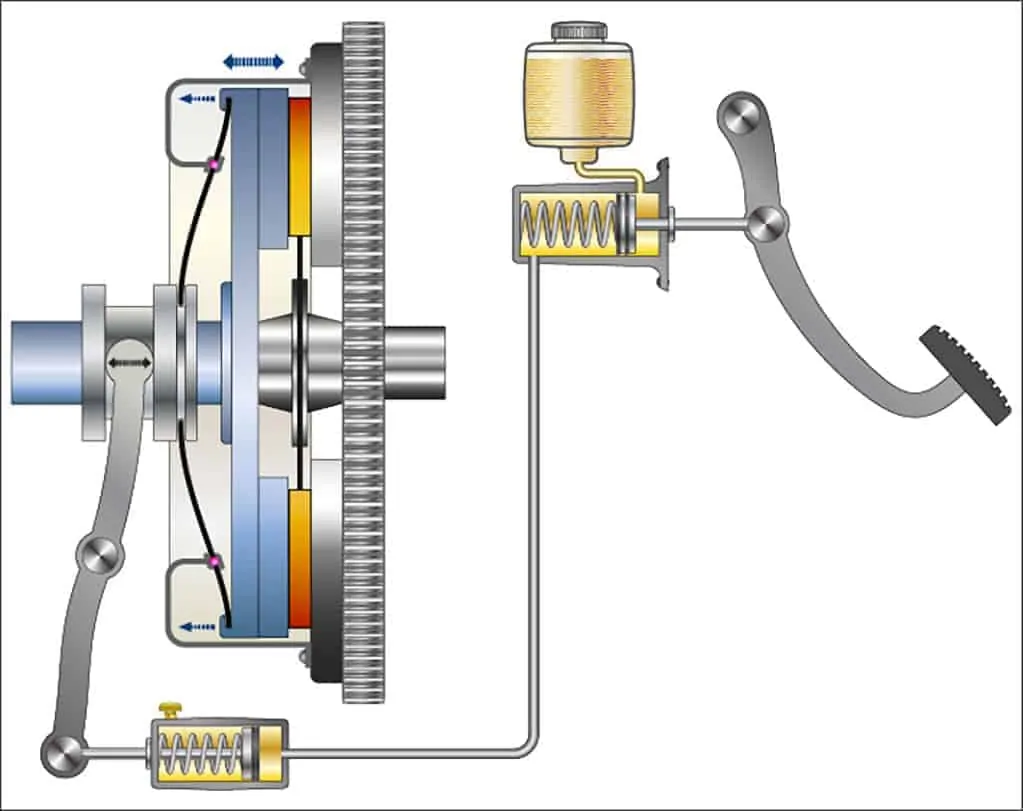
When you press on the clutch pedal, the clutch fork presses on the throwout bearing, which in turn depresses the pressure plate. This releases the pressure from the clutch disc to disengage it from the flywheel which is connected to the engine. This constant engagement and disengagement are what causes the clutch disc (made of friction material) to wear over time. Additionally, the throwout bearing can also wear out before the clutch disc, causing a squealing sound whenever the clutch pedal is depressed.
The Clutches Hydraulic System
Most modern clutch systems utilize a hydraulic system to help reduce the amount of pressure required to push on the pedal to operate the clutch. This is similar to a brake system in that is has a master cylinder with a reservoir where the fluid is contained, as well as a slave cylinder that engages the clutch fork. If your clutch pedal becomes more difficult to press down, there is a chance that the hydraulic system has failed. Over time, components in the hydraulic system can also wear out or leak requiring repair or replacement.
Clutch Services and Repairs We Perform:
- Clutch Hydraulic Fluid Leak Diagnosis
- Clutch Master Cylinder / Slave Cylinder Replacement
- Clutch Disc Replacement
- Clutch Chatter / Noise / Vibration Diagnosis
- Throw Out Bearing Replacement
- Flywheel Resurfacing
Ready to Make An Appointment For Your Clutch Service?
At Kneble’s Auto Service Center we always want to make the process of getting your car serviced as convenient as possible. To ensure that we can get your car serviced in a timely manner, we ask that you make an appointment.
We are often able to accommodate those who desire to wait for their clutch service or replacement, however most clutch-related services would require the car to be in the shop all day or possibly overnight.
For those waiting, we feature a comfortable waiting area complete with TV, complimentary refreshments, a library, a desk, and a charging station. And yes, we even have free Wi-Fi!
If you need service and have not made an appointment you can always feel free to call us at (609) 625-3286 to get on the schedule.
Please note that we offer a shuttle service within a 10 miles radius of the shop (Atlantic City, Ocean City, Margate, Pleasantville, and surrounding areas).
Frequently Asked Questions About Clutch Service and Placement:
There are many factors that will determine the life of your clutch including whether or not the vehicle is used mostly on the highways, whether or not the vehicle is frequently used for hauling (as with trucks) and the driving habits of the driver. In some cases, a clutch may only last 30,000 miles and in other cases, it might last for 100,000 miles.
This is referred to as a “clutch slipping” and is typically caused by a worn clutch disc, but in rare cases, it could also be caused by the clutch not fully being allowed to engage due to another factor. It is best to have one of our ASE Certified Technicians to assess the vehicle to make a diagnosis.
This could be caused by a few different problems, however, a worn-out pressure plate or an overheated flywheel come to mind initially. Our expert team can make a better diagnosis after inspecting and driving the vehicle.
6 signs your clutch is failing
A clutch wears gradually, and most drivers adjust to the changes without realizing the clutch is on its way out. Here are six signs that the clutch in your manual transmission needs attention:
- Burning smell when accelerating. Friction from a slipping clutch disc generates heat. If you smell something burning during acceleration, especially in stop and go traffic or on hills, the clutch is likely slipping.
- Hesitation before the car moves. You release the clutch, the engine revs, but the car takes a moment to respond. The clutch disc isn’t gripping the flywheel firmly enough to transfer power to the transmission.
- The clutch disengages too quickly. If the engagement point has shifted and the clutch grabs almost immediately off the floor, the disc is thin and nearing the end of its life.
- High RPMs at low speed. The engine revs higher than it should for the gear you’re in. This is the classic “slipping” symptom where the disc can’t hold under load.
- Spongy or soft clutch pedal. If the pedal feels mushy rather than firm, the hydraulic system (master cylinder or slave cylinder) may be leaking, or the clutch disc itself is worn.
- Clutch pedal engages higher than it used to. As the disc wears thinner, you have to let the pedal out further before the clutch catches. If you’ve noticed the engagement point creeping higher over time, the clutch is wearing down.
If you’re experiencing two or more of these, don’t wait for the clutch to fail completely. A clutch that’s slipping will only get worse, and driving on it accelerates the wear on the flywheel and pressure plate, which turns a clutch disc replacement into a bigger job. Call us at 609-625-3286 to get it checked.
Read the full video transcript
I’ve been told it’s fun to drive a stick shift, but probably not when you experience the clutch slipping. Unfortunately for me, I have no vehicle to learn on as I always wanted to drive a stick shift, so currently it’s on my bucket list.
Hi, I’m Nancy at Kneble’s Auto Service Center. I understand it’s common for a manual transmission to develop shifting problems, especially from poor shifting habits or deterioration of parts. Would you know the signs of a clutch failing in a manual transmission?
The purpose of a clutch is to give power to the gearbox, which allows the transmission to move or change gears. When your clutch slips, this refers to your clutch disengaging and engaging without delivering power to the wheels so your vehicle won’t go forward. The clutch may start to slip before it fails, and it is unable to move at all.
Six signs your clutch is starting to fail: Do you ever smell a burning odor when accelerating? When there is friction from the clutch slipping, it can cause a burning odor. Hesitation before you accelerate. This feels like the vehicle isn’t getting power to the wheels through the transmission. If the clutch disengages too quickly giving you the feeling of slipping. The RPMs are staying high when you just start to accelerate, so the speed is low and the RPMs are high. Your clutch pedal feels spongy or soft. Notice that the clutch pedal position’s higher. As it fails, you may have to let it out more for it to operate.
All these are signs when you should schedule to have your technician examine the components of your manual transmission to find the cause. Fix the problem to prevent further damage.
Schedule an Appointment for Your Clutch Service
Clutch Knowledge Base
Clutch Videos

Clutch Articles
Where to Get Your Vehicle’s Clutch Repaired?
Our Address
5473 Somers Point Road
Mays Landing, NJ 08330
Our Hours
Monday – Friday: 8:00am – 5:00pm
Saturday:
8:00am – 4:00pm
Sunday: Closed