
Table of Contents
Your car’s steering system is responsible for helping you control the direction of the vehicle as you drive. There are two types of steering systems used in cars. Parallelogram steering is used in many trucks and was used in cars prior to the development of rack and pinion steering, which is the type of steering system seen in most modern vehicles.
Below is an illustration of both steering types:
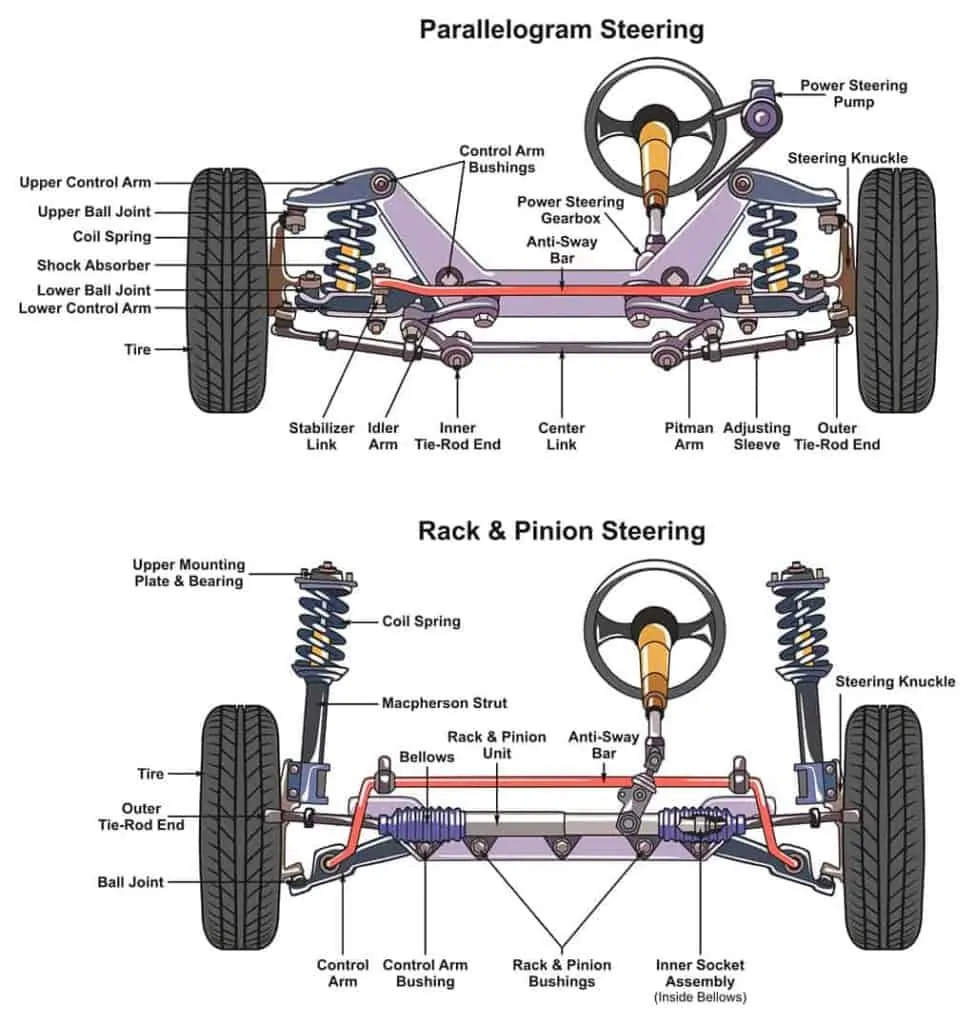
The steering column is common to both types of steering systems and includes the steering wheel attached to a telescopic shaft that connects to either the steering gearbox (in older vehicles and many trucks) or the rack and pinion steering unit. Common steering column failures include worn out tilt mechanisms or bearings. Additionally, there are often electrical components attached to the steering column such as a turn signal switch, hazard light switch, or ignition switch that can all require repairs in the area of the steering column.
The older (parallelogram) steering systems contain a series of steering links which all function to allow the wheels to move from left to right as the steering wheel is turned. These links include the pitman arm, idler arm, center link, and tie rod ends. The tie rod ends are connected on each side to the steering knuckle, which is what the wheels are attached to. Due to their frequent movement, these components are usually built with lubrication fittings to allow the joints to be filled with grease at oil changes. A common failure of these steering components includes worn joints (which often cause “loose feeling” steering), requiring a replacement of the component.
The axles connected to your steering knuckles can also wear out. Here are 6 symptoms your vehicle’s axle is going bad.
Modern rack and pinion steering units do not need to be serviced. Over time, rack and pinion units can develop leaks or other internal failures (such as worn seals) requiring replacement. Rack and pinion steering systems also utilize tie rod ends to connect the rack and pinion unit to the steering knuckles.
Whenever a steering system component is replaced an alignment is recommended.
If your steering wheel locks up when you first start the car, that’s a separate issue from general steering wear. We explain what causes it in our post on steering wheel jam at startup.
Either steering system can employ power steering, which is a hydraulic system that provides assistance to the steering process. Most modern vehicles are equipped with power steering.
If your steering feels off, there are common warning signs. Nancy covers the 3 signs that you have power steering problems in a quick video.
Steering System Repairs We Perform:
- Steering System Diagnostics
- Rack and Pinion Steering Unit Replacement
- Replacement of Pitman Arms, Idler Arms, Center Links, and Tie Rod Ends
- Front End Alignment
- 4 Wheel Alignment
- Power Steering Leak Repairs
- Power Steering Drive Belt Replacement
Ready to Make An Appointment For Your Steering System Repair?
At Kneble’s Auto Service Center we always want to make the process of getting your car serviced as convenient as possible. To ensure that we can get your car serviced in a timely manner, we ask that you make an appointment.
We are able to accommodate those who desire to wait for their steering system repair as we feature a comfortable waiting area complete with TV, complimentary refreshments, a library, desk, and a charging station. And yes, we even have free Wi-Fi!
If you need service and have not made an appointment you can always feel free to call us at (609) 625-3286 to get on the schedule.
Please note that we offer a shuttle service within a 10 miles radius of the shop (Egg Harbor Township, Mizpah, Somers Point, Cologne, Pomona, and surrounding areas).
Frequently Asked Questions About Steering Systems:
A few things could cause this including low power steering fluid, the air in the power steering system, or a power steering pump failure. We recommend having one of our ASE Certified Technician assess your vehicle to pinpoint the exact area of failure.
That is most likely caused by a loose or worn out power steering belt. If the belt needs to be tightened or replaced, we can assist you. Sometimes a pulley will fail and cause similar noise. In any case, our highly trained ASE Certified Technicians will be able to diagnose the exact cause of the noise.
It is possible that there is a bearing failure or another mechanical failure within the steering column. We would be happy to have one of our technicians to inspect your vehicle and pinpoint the problem.
Steering fluid types: which one does your car need?
Not all power steering systems use the same fluid, and using the wrong one can cause damage ranging from seal deterioration to complete pump failure. The type of fluid your car needs depends on the steering system design.
Hydraulic power steering with ATF. Many domestic vehicles (Ford, Chrysler, GM) and some Volkswagen models built in the US use automatic transmission fluid (ATF) as power steering fluid. If your owner’s manual specifies ATF, that’s what goes in. Don’t substitute a generic “power steering fluid” unless it meets the same spec.
Hydraulic power steering with synthetic fluid. European manufacturers like Mercedes, BMW, Audi, and Porsche often require a synthetic power steering fluid that meets specific viscosity and temperature stability requirements. These fluids are engineered for quicker steering response and better performance across a wider temperature range. Using ATF in a system designed for synthetic fluid can damage the seals and reduce the life of the pump.
Electric power steering. If your vehicle has electric power steering (increasingly common in newer cars), there is no fluid at all. The system runs on an electric motor, so there are no hoses, no pump, and no fluid flushes to worry about.
Check your owner’s manual to find out which system your car has. If you’re topping off or flushing the power steering fluid, make sure you’re using what the manufacturer recommends. Using the wrong fluid or skipping the recommended flush interval can cause problems. If you’re hearing a whine or feeling resistance when you turn the wheel, the steering system needs attention. Call us at 609-625-3286.
Vehicles with hydraulic power steering share some components with the transmission system (ATF is the same fluid in many cases), so if you’re seeing fluid leaks under the car, it’s worth having both systems checked.
After any steering component repair, a wheel alignment is recommended to make sure the wheels track straight.
Read the full video transcript
Are you struggling to turn your steering wheel? For those of you who remember manual steering, well, that brings back some memories. This struggle to turn could be a sign of a power steering leak. You can refer to my video on three signs of a power steering problem.
Hi, I’m Nancy at Kneble’s Auto Service Center. Once you have the cause of your power steering leak repaired, be aware as vehicles are continuing to evolve with technology, your vehicle may be designed with an electric power steering, hydraulic power steering or hydraulic and electric power steering system.
Hydraulic power steering needs fluid to operate. There are a variety of fluids. So make sure you use the manufacturer’s recommendation when adding or changing fluid. ATF, or automatic transmission fluid, is used as power steering fluid in many models, such as Ford, Chrysler, GM, and certain model Volkswagens that were built in America.
Laboratory produced power steering fluid is designed for high performance vehicles such as Mercedes, BMW, Audi and Porsche. This type of power steering fluid is a synthetic base fluid and it meets certain specifications such as viscosity, lubrication qualities, and provides better temperature stability, giving a quicker response time when initially steering.
Oh, and by the way, for those vehicles with only electric power steering, you don’t use any fluid. Your power steering operates with an electric motor. Therefore, you have no power steering leaks, with hoses and pumps, and no power steering fluid flushes needed.
So the next time you grab a bottle of power steering fluid, make sure you check your owner’s manual to determine if your vehicle uses power steering fluid, which type, and when you should have your power steering fluid flushed. Using the wrong fluid or not following the manufacturer’s recommendation for flushing the system may cause damage to your system from minor or major.
Schedule an Appointment for Your Steering System Repair
Steering System Knowledge Base
Steering System Videos




Steering System Articles
Should I Repair or Replace My Vehicle?
Dealing with a damaged vehicle, but unsure whether you should repair it or replace it? Use this guide to help you make your decision today!
Where to Get Your Vehicle’s Steering System Repaired?
Our Address
5473 Somers Point Road
Mays Landing, NJ 08330
Our Hours
Monday – Friday: 8:00am – 5:00pm
Saturday:
8:00am – 4:00pm
Sunday: Closed